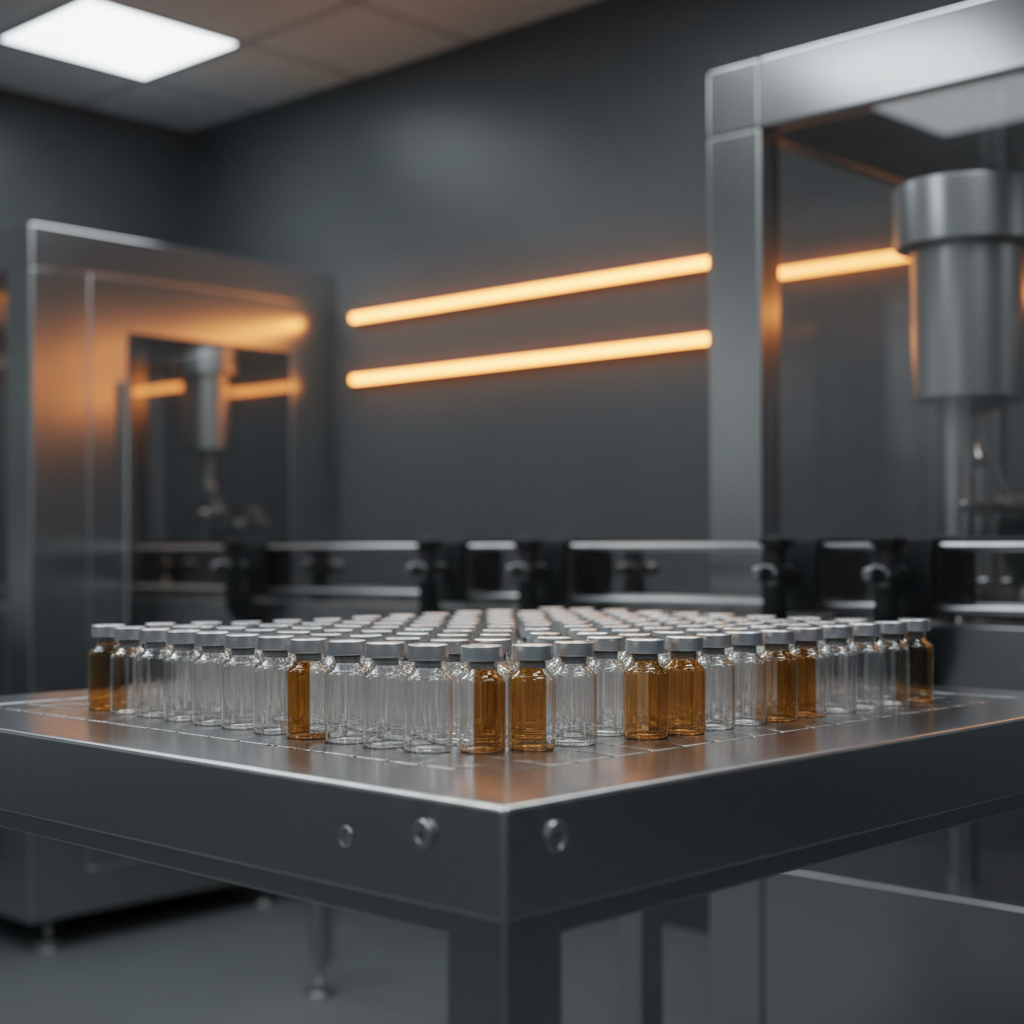
Buffer The Surge. Balance The Line. Keep It Running.
Accumulation Tables for Every Packaging Line
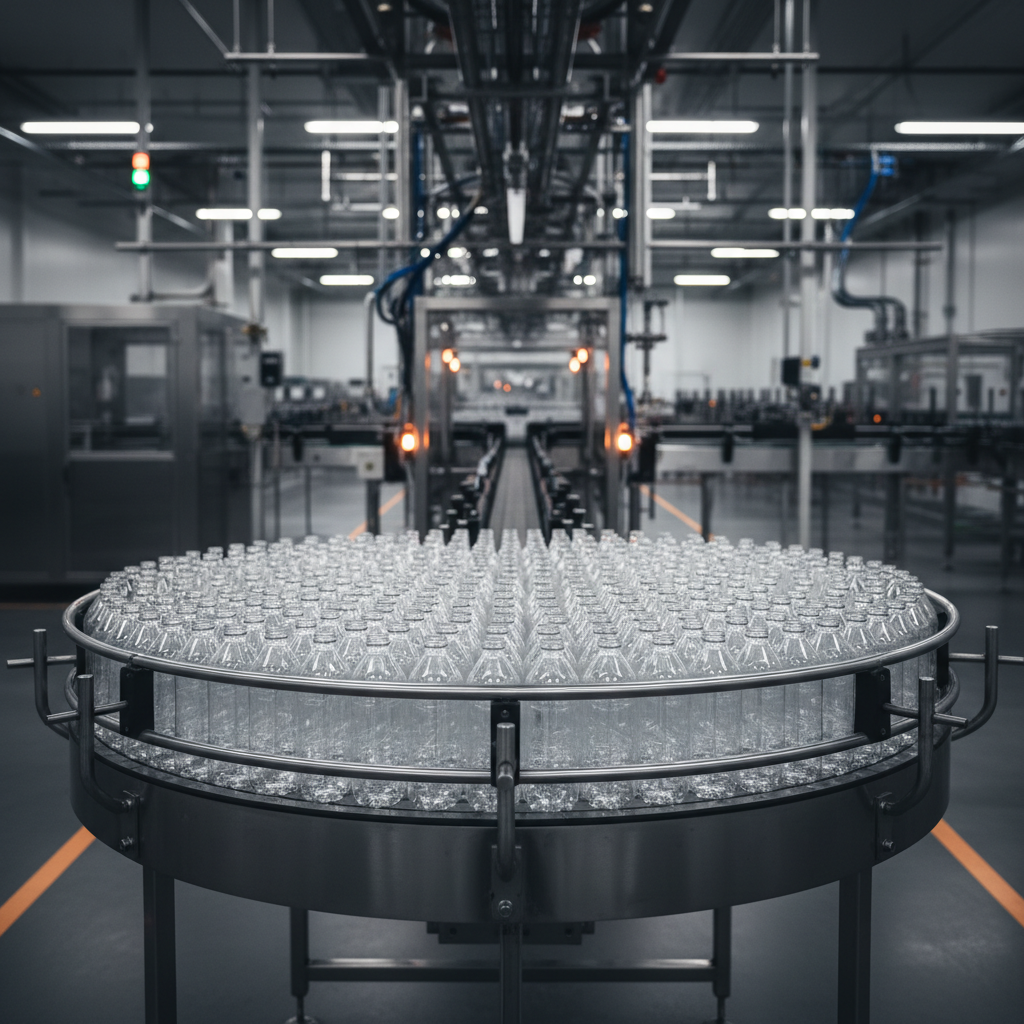
Heavy-duty accumulation tables for beverage bottlers, food and sauce packers, pharmaceutical and nutraceutical lines, and personal care and cosmetics manufacturers. A stalled capper or labeler no longer stops the whole line, with stainless washdown discs, VFD speed control and backlog sensors wired into the conveyors either side.
common rotary disc diameters, larger built to order
FIFO or LIFO
flow order depends on the accumulator type
304 / 316L
stainless grades specified for washdown duty
Line balancing
How an accumulation table keeps a line running
A packaging line is a chain of machines running at different natural rates, and every one of them stops sometimes. A labeler runs out of reel. A capper jams on a crooked closure. A case packer waits for an operator, or a palletiser waits for a pallet. Without somewhere for containers to go, that stop propagates backwards in seconds and the filler, the most expensive and least willing machine to restart, goes down with it.
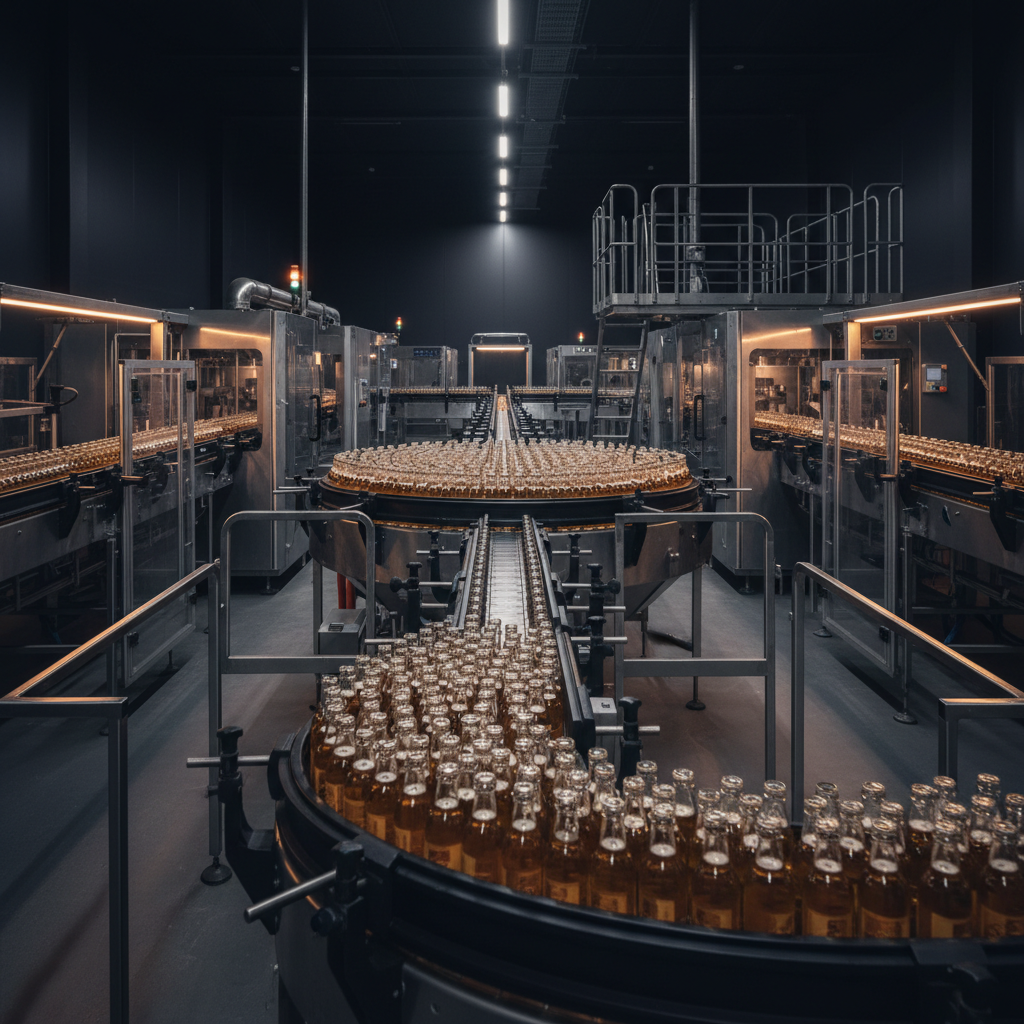
An accumulation table is the place containers go instead. It sits between two machines and holds a bank of containers standing upright on a wide surface. When the downstream machine stops, containers keep arriving and spread out across the table rather than backing up. When it restarts, the bank drains back into single file. The line only goes down when the buffer runs out, which is why the size of the table is really a statement about how long a stop you intend to survive.
The same buffer solves the opposite problem. Where one operation is genuinely slower than the rest, a hand-pack station or an inspection step, a table lets the faster machines run continuously in batches and lets the slow operation work through a bank at its own pace. The line stops being a chain that runs at the speed of its weakest link and starts being two halves that meet at a buffer.
The buffer surface
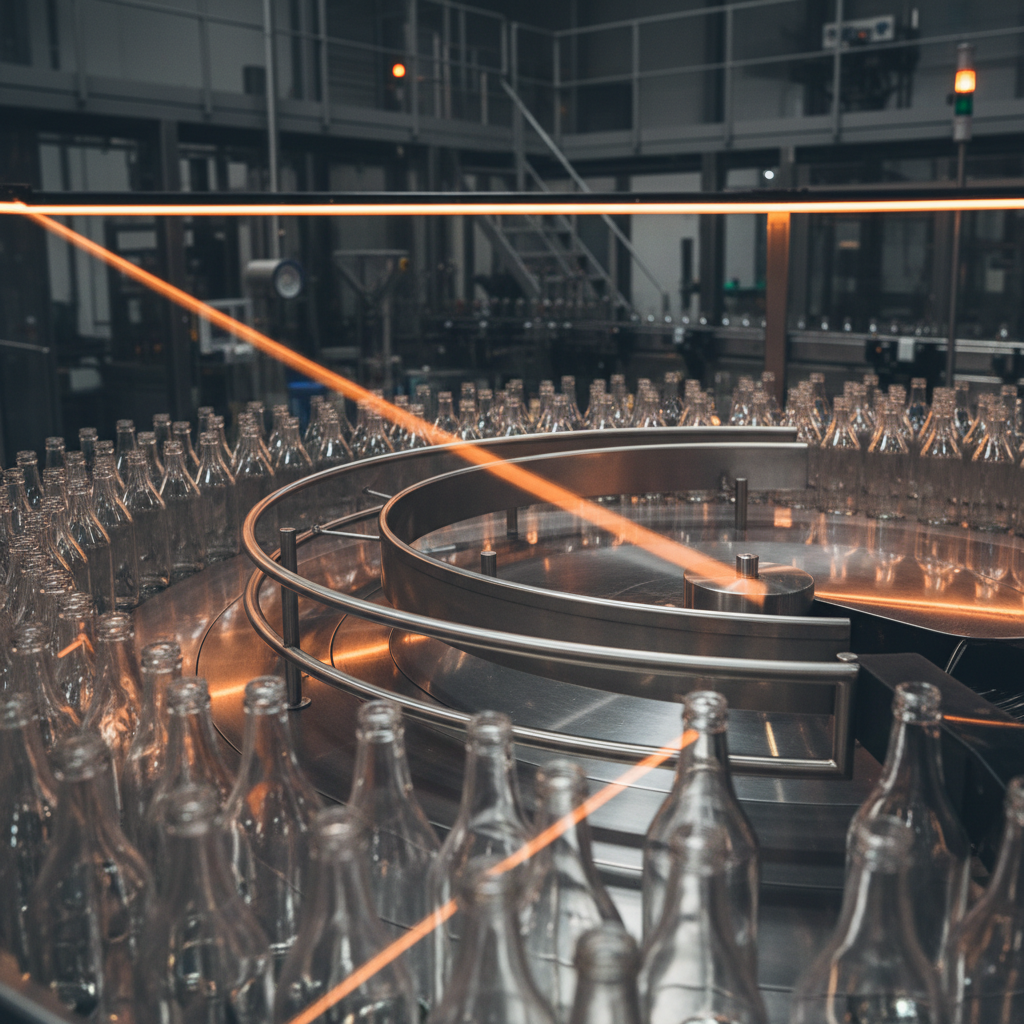
A slowly turning stainless disc, or on a serpentine unit a folded run of mat-top chain, wide enough to hold containers several rows deep. It is the surge capacity itself: the place a container stands when the next machine cannot take it yet, instead of backing all the way up the line to the filler.
Guide rails and spiral flow
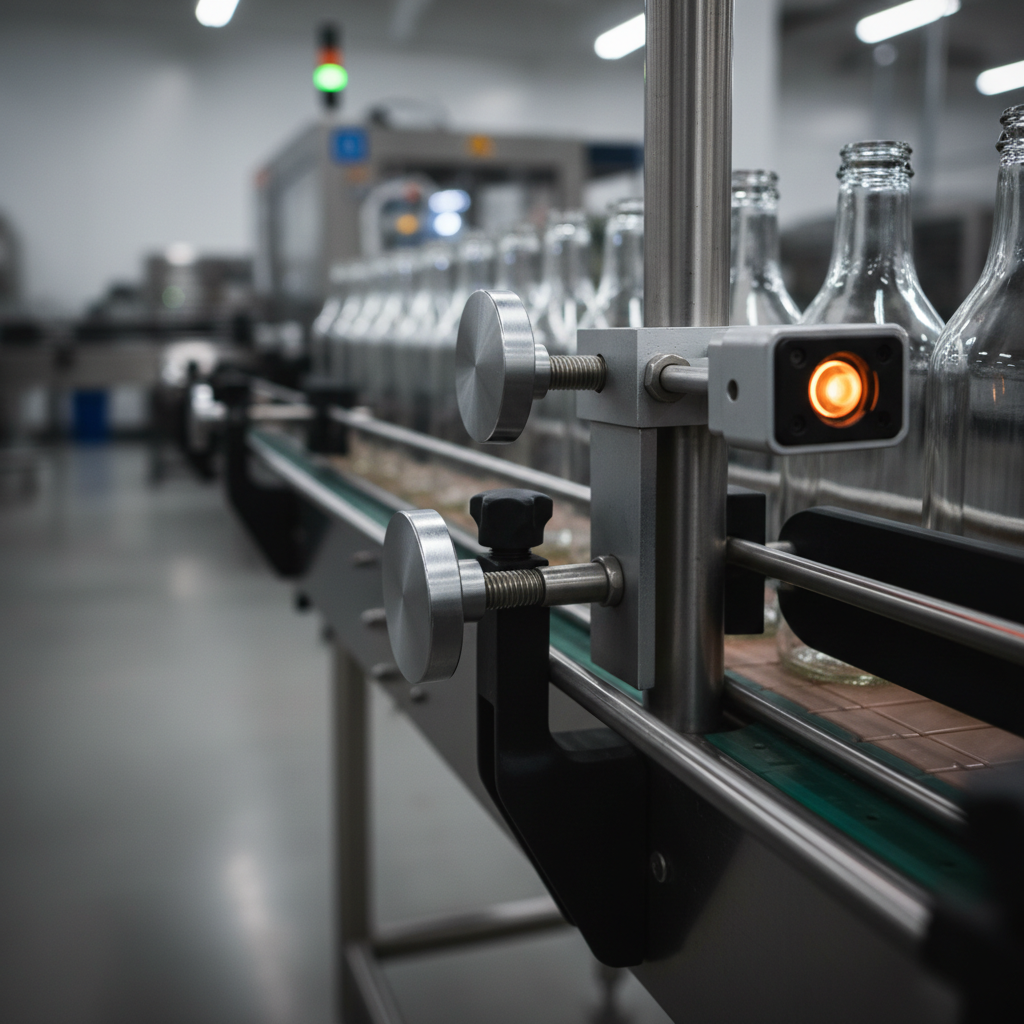
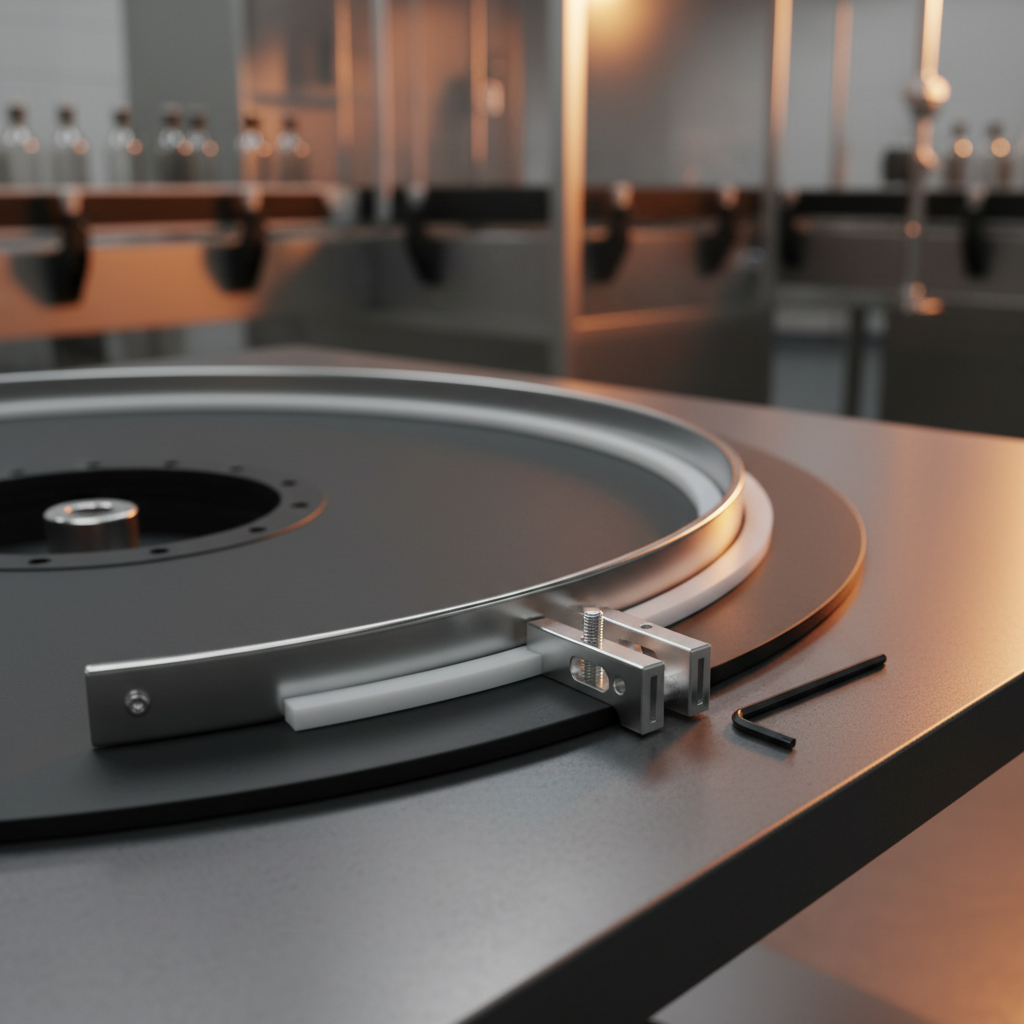
Curved rails clamped above the disc steer containers in a spiral. As the bank fills, arriving containers are carried outward toward the rim; as it drains, the rails walk them back inward to the discharge gap and into single file. Rail angle and clamp position are the main adjustments on the machine.
Backlog and starvation sensors
Photo-eyes watch the infeed and the discharge. A backlog eye seeing a full table slows or stops the upstream machine before containers jam. A starvation eye seeing an empty discharge tells the table there is nothing to feed. Between them the table stops being a passive turntable and becomes part of the line control.
Variable frequency drive
The disc runs from a gearmotor on a VFD so surface speed can be tuned to the container. Fast enough to clear the infeed, slow enough that light or tall containers are not tipped or scuffed as they are swept against a rail. On integrated lines the drive takes its speed reference from the line PLC.
First in, first out, and when it matters
A rotary disc does not preserve order. Containers spiral outward as the bank builds and are drawn back from the inside as it drains, so a container that arrives early can leave late, and the flow is closer to last in, first out than to a queue. For empty containers on their way to a filler this is completely irrelevant. For filled product carrying a date, batch or serial code, or for anything with a short window between fill and seal, it is not. That single question, whether order has to survive the buffer, is what pushes a specification from a rotary table to a serpentine or lane accumulator.
Back pressure, low pressure and pressureless
On a conventional table the disc keeps turning under a stationary bank, so containers are pressed against the guide rails and against each other. That force is back pressure, and it is what makes the bank feed itself out again without any help. It also scuffs decorated surfaces, tips tall containers and crushes thin-wall ones. Low-pressure designs reduce it with rail geometry and slower surface speed. Pressureless accumulators remove it entirely by carrying containers on driven lanes instead of sweeping them, which is the only real answer for fragile, light or printed containers.
The line-up
Configurations and how they differ
Every accumulation table does the same job: hold containers upright somewhere off the critical path and give them back in single file. What separates the formats is the shape of the surface they stand on, whether containers are swept or carried, and whether the machine has to fit around a line that cannot be moved.
Rotary turntable accumulation tables
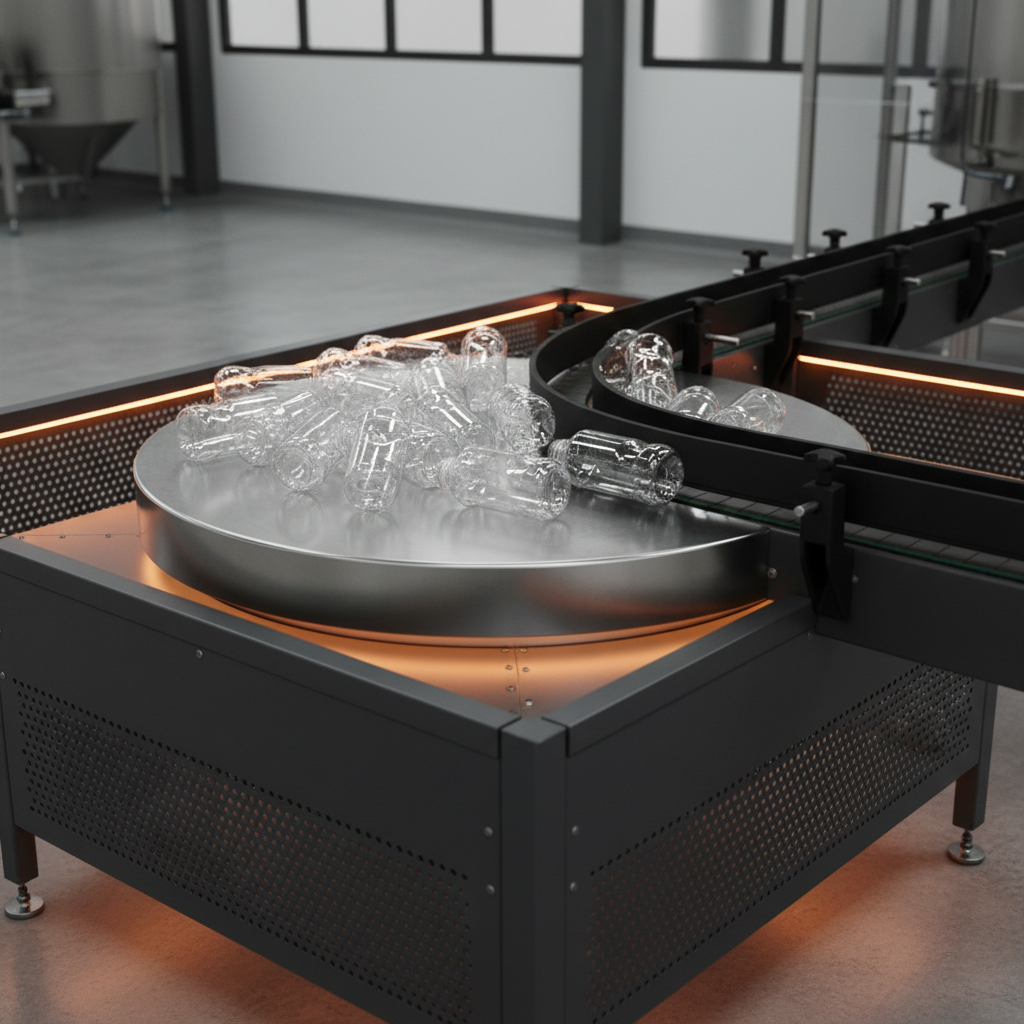
The standard machine and the one most people mean by the term. A single round disc, commonly from about 24 in (600 mm) up to 72 in (1.8 m) and larger on request, turns continuously under a set of guide rails. Containers arrive on one side, spiral outward as the bank builds, and spiral back to a discharge gap as it drains. Cheapest surge capacity per container held, and simple enough that a maintenance team can adjust and repair it without a specialist.
Widest range of disc diameters, so capacity is easy to dial in
Simple mechanically: one gearmotor, one disc, a set of rails
Flow order is closer to last in, first out than strict FIFO
Bi-directional (bi-flow) tables
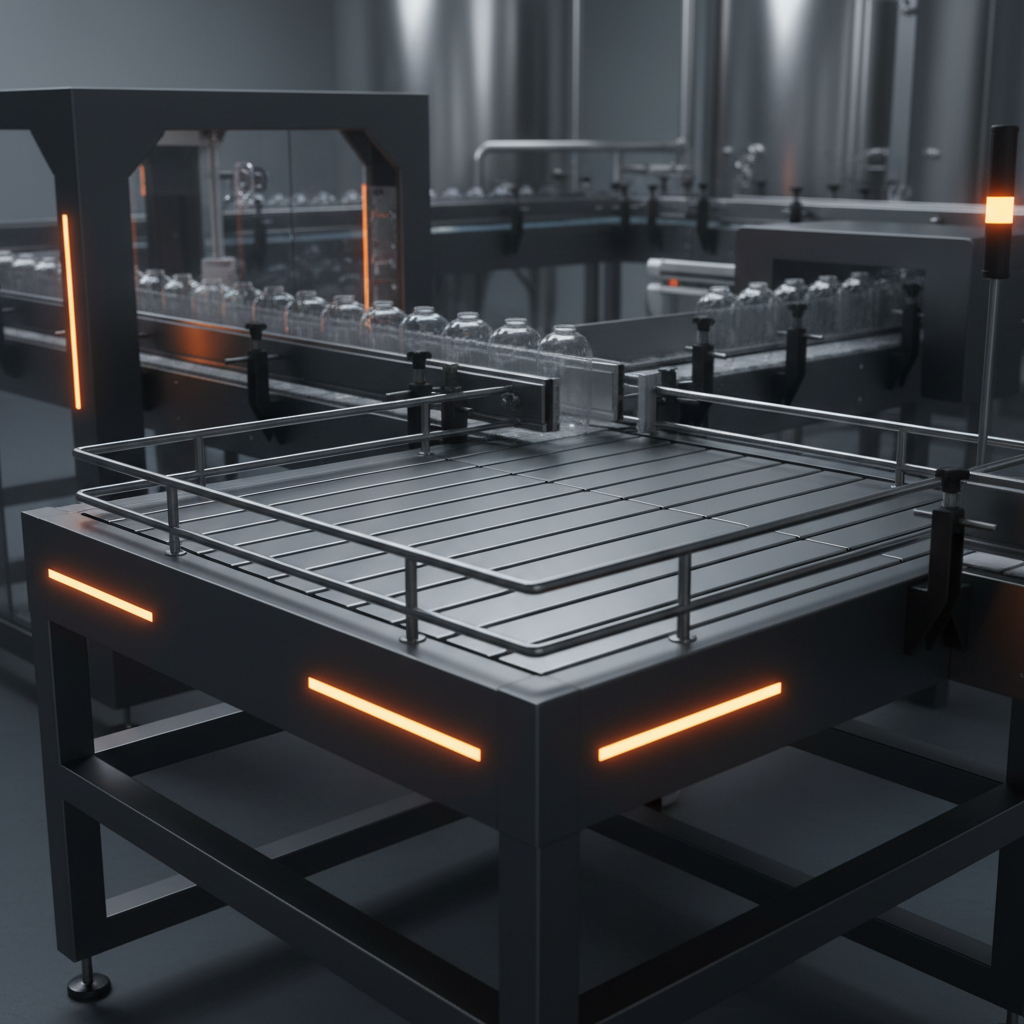
A table that both accepts containers off a conveyor and returns them to the same conveyor further along, so the line stays on one axis and the accumulator lives beside it rather than in it. Useful when a line runs down a wall or between two fixed machines and there is no room to break the flow around a full circle. Capacity is set by bed width and length rather than by disc diameter.
Keeps the line in a straight run, which suits constrained layouts
Fills and drains on the same conveyor, so only one interface to build
Bed geometry rather than a circle, so odd floor spaces can be used
Serpentine and multi-lane recirculating accumulators
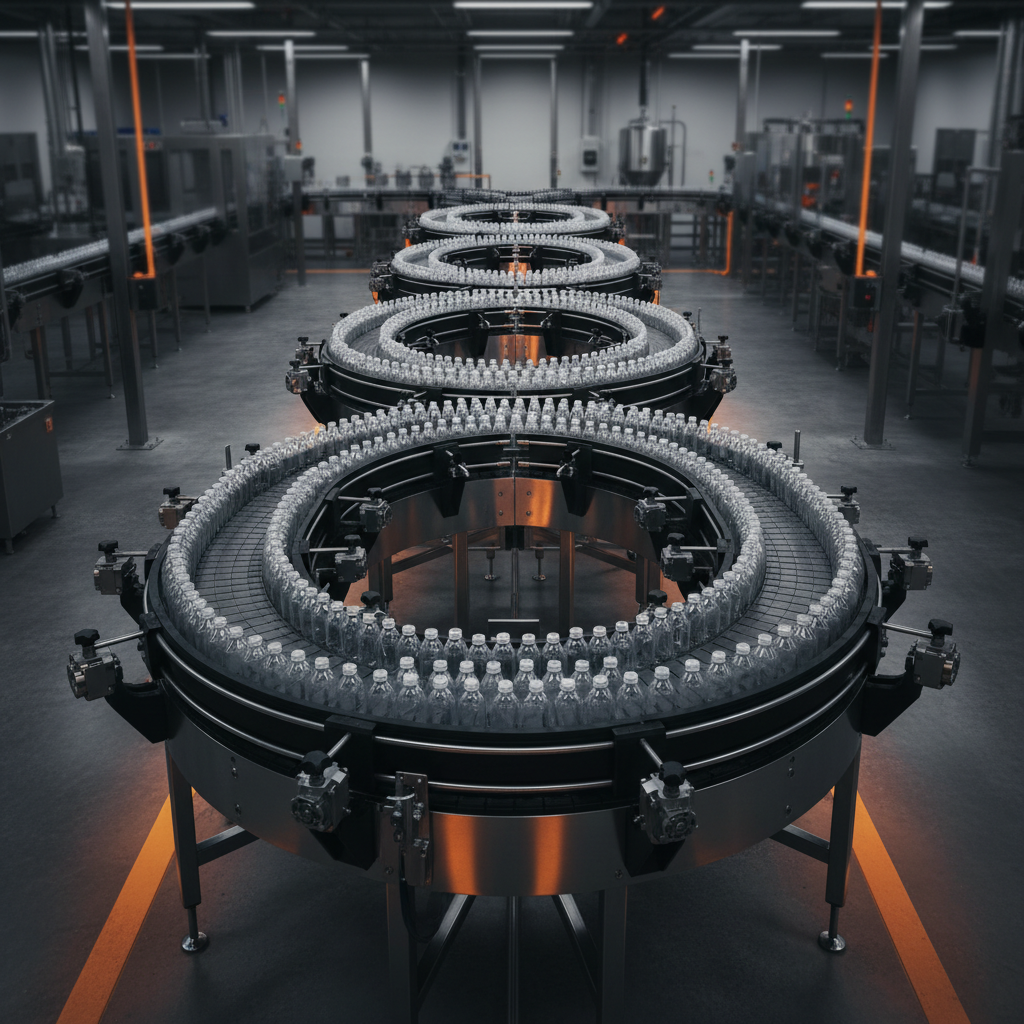
Several lanes of mat-top chain folded back on themselves so the container path is long while the footprint stays rectangular and compact. Containers are carried rather than swept, which means the accumulation is pressureless: nothing is pushed against anything else. This is what high-speed lines use, and it is the configuration to specify when order matters and containers will not tolerate contact.
Strict first in, first out, so batch and date order survives the buffer
Pressureless, so light, tall and decorated containers are not damaged
Highest capacity per square metre of floor, and the highest cost
Unscrambling and pack-off turntables
The same disc doing a different job at the two ends of the line. At the start, an operator tips loose containers onto the table and a rail funnels them into single file for the filler. At the end, finished containers, cartons or bundles collect on a disc where a packer works around them. Neither is strictly a buffer, but both are built on the same frame, drive and rail hardware.
Feed tables turn a bulk pile of containers into a single file
Pack-off tables give a packer a moving surface to work around
Same frame and drive as an accumulation table, different rail set
Low-profile and puck-carried tables
Small containers need a disc that sits close to the conveyor top so nothing is lifted or dropped at the handoff, which is what a low-profile table provides. Containers that will not stand at all, ampoules, tapered bottles, pouches and tubes among them, ride in a puck or carrier so that a stable, uniform base is what actually touches the disc. The table then handles a well-behaved cylinder whatever the product looks like.
Low-profile decks match small-container conveyor heights
Pucks give unstable containers a stable base and a uniform diameter
Puck return has to be designed into the layout from the start
Custom footprints and non-round beds
Where a round disc will not fit, the bed changes shape. Oval and D-shaped tables recover capacity against a wall. Cut-away discs clear a column or a doorway. Tables are also built with the infeed and discharge on the same side, on opposite sides, or at an angle set by the machines either side. The rail set and the drive are unchanged; only the bed and the frame are drawn to suit.
Oval and D-shaped beds recover capacity in a constrained bay
Infeed and discharge positions set by the machines either side
Worth a layout drawing before ordering, not after
When a length of accumulation conveyor is enough
Not every line needs a table. A straight run of accumulation conveyor, single file with a low-friction chain and a backlog eye, buys a modest buffer for the cost of a few metres of conveyor and no extra floor space at all. On a slow line with a short worst-case stop, that is often the right answer, and specifying a table instead just takes up a bay.
The arithmetic decides it. Single-file accumulation holds one container per container length of conveyor. A table holds containers several rows deep across its whole surface, so a modest disc replaces a very long run of conveyor. Work out the container count you need first, see how many metres of single-file conveyor that would be, and the answer usually becomes obvious without any further debate.
Construction
Materials, finish and sanitary design
An accumulation table lives in the wettest, dirtiest part of a packaging hall, directly under whatever the filler spills. What it is made of therefore decides how long it lasts and whether it passes an audit, and those decisions cannot be reversed later. Stainless frames in 304, or 316L where chlorides and aggressive cleaning chemistry are present, are standard for wet plants; powder-coated carbon steel is a sensible saving on dry goods.
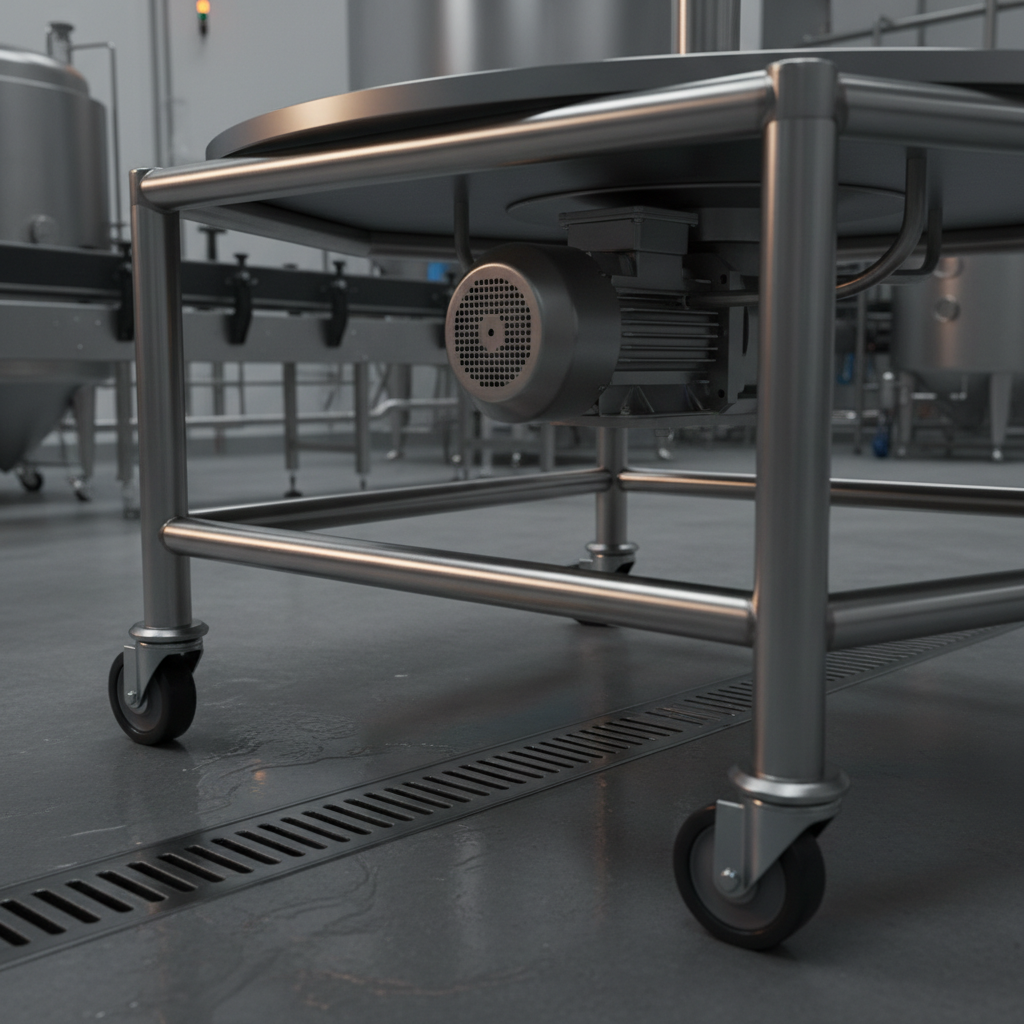
Sanitary design is about shape as much as material. Open tubular frames with no boxed sections, sloped surfaces that drain rather than pond, welds ground smooth, and no flat ledges for water and product to sit on. Motors are sealed to IP65 or IP69K because they are under the disc and will be hosed. Controls go in a NEMA 4X or IP66 stainless enclosure for the same reason.
Everything the container touches is a wear part by design. UHMW polyethylene disc overlays and rail facings are chosen because they are slippery, quiet and cheap to replace, and because they take the wear instead of the stainless underneath them. Guide rails mount on round support rods with knurled clamp knobs so a container changeover is a hand adjustment, and legs are height-adjustable with levelling feet, or feet and casters where the table moves between lines.
Component
Typical specification
Notes
Frame, legs and guarding
304 stainless, or powder-coated carbon steel
Stainless for washdown, wet floors and sanitary audits; powder-coated carbon steel is a sound saving on dry goods lines. Open tubular frames with no flat ledges shed water and are the sanitary-design default. Legs should be height-adjustable, with levelling feet or a foot-and-caster combination if the table will be moved between lines.
Disc or bed surface
304 or 316L stainless, or a UHMW polyethylene overlay
316L where chlorides or aggressive cleaning chemistry are present, 304 for general food and beverage duty. A UHMW overlay lowers friction so containers slide instead of dragging, cuts base scuffing on clear containers, and can be replaced without touching the disc underneath.
Guide rails
Stainless rod and clamp with UHMW or acetal facing
The plastic face is the wear part and the container-contact surface. Rails mount on round support rods with knurled clamp knobs so changeover between container diameters is a hand adjustment rather than a tool job. Record the settings for each container so a changeover is repeatable.
Conveying chain (serpentine)
Acetal or polypropylene mat-top and tabletop chain
Mat-top gives a wide flat carrying surface across multiple lanes; tabletop chain suits single-file runs. Both are run dry on modern lines with low-friction wear strip, which removes soap or oil lubrication and the sanitary problem that comes with it.
Drive and gearmotor
Sealed washdown gearmotor, IP65 or IP69K, on a VFD
The motor sits under the disc where it will be hosed, so the ingress rating is not optional in a wet plant. A VFD is worth having even on a fixed-speed application, because the right disc speed for a given container is found on commissioning rather than known in advance.
Controls and enclosure
NEMA 4X or IP66 stainless enclosure
Holds the drive, the sensor terminations and the local controls. Keep the e-stop circuit tied into the line so that stopping the conveyor stops the disc, and make sure the guarding around the disc rim and any pinch point at the infeed is in place before the table is run.
Guarding, noise and the things that get skipped
The rotating disc rim and the gap where it meets the conveyor are the two pinch points on the machine, and both need guarding designed in rather than added after an incident. Noise is the other quiet cost: a bank of glass containers pressing against a stainless rail is loud all shift, and a plastic rail facing plus a slower disc speed does more for that than any enclosure will.
Ask for the layout drawing before the order goes out, with the disc, the rail swing at every container size, the conveyor centres either side and the operator standing positions all on the same sheet. It is a short conversation before delivery and an expensive one afterwards.
Where they are used
Applications by industry
The machine is the same everywhere: a wide surface, a set of rails, a drive and a pair of sensors. What changes between industries is the container, the speed, whether the plant is hosed down at the end of the shift, and how much it costs when the line stops.
Beverage bottling
Water, soft drinks, craft beer, spirits and wine lines run rinse, fill, cap, label and pack in sequence, and the labeler is the machine most likely to stop. A table between labeler and case packer lets the filler keep running through a label reel change instead of stopping and restarting, which on a carbonated product is worth more than the machine costs.
Keeps a continuous filler running through a downstream stop
Round glass and PET bottles are ideal candidates for a rotary disc
Stainless and washdown construction is the norm in a wet bottling hall
Pharmaceutical and nutraceutical
Vials, small bottles and tablet containers run at moderate speed with high value per unit, and the packaging line carries inspection, serialisation and labelling stations that stop for reasons the filler cannot control. Buffering between them protects the batch, but the accumulator has to hold order so that a serialised container stays where the record says it is.
First in, first out matters where units carry serial or batch data
Small, light and tapered containers often run in pucks
Cleanable surfaces and documented construction for validated lines
Food, sauces and condiments
Jars and bottles of sauce, dressing, honey and preserves run through hot fill, capping, cooling and labelling, and a cooling tunnel or a labeler stop should not back up into a filler holding hot product. Sticky spillage and daily washdown push these lines to stainless frames and UHMW surfaces that can be hosed and scrubbed without damage.
Personal care and cosmetics
Shampoo, lotion and cosmetics containers are decorated, often oval or flat-sided, and scuffing a printed surface is a rejection. That combination favours pressureless accumulation, wider rail radii and slower disc speeds, and it makes the plastic facing on the guide rails a quality control item rather than just a wear part.
Household chemicals and lubricants
Bleach, detergent, motor oil and industrial chemistry come in heavy handled bottles and jugs that behave differently from a round bottle: the handle catches on rails and the mass makes them slow to start and stop. Rail geometry gets designed around the handle, and 316L is the usual specification where the product itself is aggressive.
Cannabis packaging
Jars, tubes and child-resistant containers run on compact lines that were often assembled machine by machine as the operation grew. An accumulation table is frequently the first piece of line-balancing equipment such a plant buys, because it lets a fast filler and a slow hand-pack station coexist without one waiting on the other.
Contract packagers
A co-packer runs whatever the contract brings, so the table has to change over between container sizes quickly and repeatedly and be moved between lines. That argues for casters as well as levelling feet, generous rail adjustment, marked or scaled rail settings, and a disc sized for the biggest job rather than the current one.
Getting the spec right
Sizing and selection
Sizing an accumulation table is arithmetic, not judgement, and the arithmetic is short. Almost every disappointing table on a plant floor was sized against an average stop instead of a worst-case one, or against the container that was running the week the order went out.
Worked example
A line runs 120 containers per minute. The containers are round bottles with a 75 mm base. Downstream stop logs show the labeler and case packer clear most faults inside a minute, but the worst stops run to three minutes.
1Containers to hold: 120 per minute multiplied by 3 minutes gives 360 containers.
2Footprint per container: take the square of the base diameter as a planning figure, so 0.075 m by 0.075 m gives 0.0056 square metres each.
3Raw area needed: 360 multiplied by 0.0056 gives 2.03 square metres of containers.
4Packing allowance: containers on a turning disc never pack perfectly, so divide by 0.65, giving about 3.1 square metres of usable disc.
5Disc diameter: a disc of 3.1 square metres is close to 2.0 m across, which is larger than a standard 72 in table.
The useful part of that answer is the conclusion it forces. Three minutes of buffer at 120 containers per minute is past what one rotary disc will hold, so the real options are a serpentine accumulator, two tables in series, or a decision to accept two minutes of buffer instead of three. Running the arithmetic before the order is what turns that into a choice rather than a discovery.
Approximate capacity by disc diameter
Geometry only, at 65 percent packing. A planning figure to size against, not a specification.
Disc
Area m2
65 mm
90 mm
24 in / 610 mm
0.29
45
23
36 in / 915 mm
0.66
100
53
48 in / 1220 mm
1.17
180
94
60 in / 1524 mm
1.82
280
145
72 in / 1830 mm
2.63
405
210
Divide a container count by your line speed to read the figures as buffer minutes. A 72 in disc holding 405 bottles of 65 mm is about three and a half minutes at 120 containers per minute, or under two minutes at 240.
01
Line speed and buffer time
The two numbers everything else follows from. Containers per minute at full rate, multiplied by the longest downstream stop you intend to ride out, gives the container count the table must hold. Log real stop durations for a fortnight rather than guessing, and size near the top of that spread instead of the average.
02
Container size, shape and stability
Base diameter sets how many containers fit per square metre. Height-to-base ratio and weight set how fast the disc can safely turn. Round containers spiral cleanly; square, oval and handled containers snag on rails and often need a wider rail radius or a pressureless machine instead.
03
Direction of flow and layout
Decide which side the containers arrive on, which side they leave on, and which way the line turns. A rotary table can be built to accumulate clockwise or anticlockwise, but that has to be specified. Where the line must stay straight, a bi-directional table is the machine, not a round one squeezed into the run.
04
First in, first out, or not
A rotary disc mixes the bank, so a container can sit in the middle and leave late. That is irrelevant for empty containers and a real problem for filled product with a date or batch code. If order has to survive the buffer, specify a serpentine or lane accumulator and accept the cost.
05
Washdown rating and sanitary design
If the machine gets hosed, everything changes: stainless frame, sealed and rated gearmotor, open frame with no water-trapping ledges, sloped surfaces, and a controls enclosure to match. Retrofitting sanitary construction onto a dry-goods table is not practical, so decide this before the order.
06
Infeed height and conveyor interface
The disc has to sit level with the conveyor surface either side, and the gap has to be bridged by a dead plate or comb so no container base can drop into it. Check the height range the adjustable legs actually give you against your existing conveyor centres. Retrofits fail here more often than anywhere else.
07
Controls integration
Backlog and starvation photo-eyes, a VFD for disc speed, and a defined interface to the line: hardwired signals to the neighbouring machines, or a PLC connection. Agree who supplies what, and make sure the e-stop circuit is common so stopping the line stops the table.
08
Changeover time and repeatability
A plant running four container sizes will change over the rails hundreds of times over the machine's life. Ask how the rails adjust, whether the settings can be marked or scaled so a changeover is repeatable, and how long the supplier says it takes. Then double that number and see if it still fits the shift.
09
Footprint against the cost of downtime
The budget question is not what the table costs, it is what a stopped line costs per minute and how many of those minutes the table buys back. A table that is one size too small is the worst outcome, because it takes the floor space and still lets the line go down on the stop it was bought to absorb.
On the floor
Installation and maintenance
An accumulation table is a simple machine and it fails in simple ways: a table half an inch low, a rail set for the wrong container, a photo-eye aimed at the wrong point in the flow. Get the commissioning right and the routine is a wipe down, a look at the wear strip and an occasional gearbox check.
Commissioning sequence
1Level the table in both axes and set the disc surface flush with the conveyor either side, then lock the levelling feet.
2Close the gap at the infeed and discharge with a dead plate or comb so no container base can catch or drop in.
3Set the guide rails for the first container: entry angle, sweep radius and discharge gap, then run a bank through by hand before powering up.
4Position the backlog and starvation photo-eyes where they see the condition you actually want to act on, not simply where the bracket reaches.
5Tune the disc speed on the VFD with real containers, starting slow and raising it only until the infeed clears reliably.
6Prove the sensor logic and the e-stop circuit end to end with the neighbouring machines before the table carries production.
Record the rail settings for every container
The single highest-value habit on the machine. Mark or scale the rail positions for each container the plant runs, and write them down. A changeover then becomes a five minute job that anyone on shift can do, instead of half an hour of trial and error by whoever happens to remember how it went last time.
Treat wear strip and rail facing as consumables
UHMW rail facing and disc overlay are there to be worn away instead of the stainless. Check them for grooving and thinning on a schedule, keep a length of each on the shelf, and replace before a worn rail starts marking containers or a grooved strip starts snagging bases.
Clean the disc, and clean under it
Product residue on a disc raises friction, which slows containers, raises back pressure and makes the drive work harder. Sugar syrups and sauces are the usual offenders. Wash the surface as part of the shift routine and get under the disc periodically, because that is where spillage collects around the drive.
Keep photo-eyes clean and aligned
A lens with a film of product on it is the most common cause of a table that has stopped controlling the line properly, and it presents as an intermittent fault rather than a failure. Wipe the lens and the reflector on the same round as the disc, and check alignment after anyone has worked near the bracket.
Look after the drive, which asks for very little
Modern gearmotors on these tables are sealed and largely maintenance free, so the job is watching for the exceptions: a rising noise, a hot casing, a weep at the output seal. On washdown machines check that the hose is not being aimed directly at the seal, because that is what defeats an otherwise perfectly good rating.
Guard it, and lock it out to work on it
The disc rim and the infeed gap are the pinch points, and a disc that turns slowly is still driven by a gearmotor with plenty of torque. Keep the guarding fitted rather than left off after a changeover, and apply the plant lockout procedure before anyone reaches under the deck.
Common questions
Accumulation table FAQ
What is an accumulation table?
An accumulation table is a packaging-line machine that holds a bank of containers between two pieces of equipment so that a stop at one of them does not stop the whole line. Containers arriving faster than the next machine can take them are pushed out onto a wide surface, usually a slowly turning stainless disc, where they stand and wait. When the downstream machine restarts, guide rails feed the bank back into single file and the buffer drains. The same machine is also called a rotary accumulation table, an accumulating table, a turntable accumulator, or simply a bottle table, and the terms are used interchangeably.
What is the difference between rotary, bi-directional and serpentine accumulation?
A rotary table is a single round disc that turns continuously under a set of guide rails; containers spiral outward as the bank fills and spiral back in as it drains. A bi-directional table sits alongside a straight conveyor and both accepts containers off it and feeds them back onto it, which keeps the line in one axis and suits tight layouts. A serpentine accumulator is a multi-lane mat-top conveyor folded back on itself so the container path is long while the footprint stays compact, and it holds strict first-in-first-out order at speeds where a rotary disc would be losing containers. Rotary is the cheapest per container held, serpentine is the most controlled, and bi-directional sits between them.
How do I size an accumulation table?
Start with two numbers: the line speed in containers per minute, and the longest downstream stop you actually expect to ride out. Multiply them to get the container count the table must hold. Then convert that count to a disc area using the container footprint, which for planning purposes is the square of its base diameter, and divide by a packing efficiency of roughly 0.6 to 0.7 because containers on a turning disc never pack perfectly and the outer band does most of the work. That area gives you the disc diameter. A line running 120 containers per minute that needs 3 minutes of buffer wants 360 containers held, and 75 mm bottles at that count need close to 3 square metres of usable disc, which is beyond a single rotary table and points at either a serpentine accumulator or two tables.
How much buffer time is typical?
Most lines are specified somewhere between 1 and 5 minutes of buffer at full speed, and the number is set by the failure you are protecting against rather than by any rule. A labeler that jams and clears in under a minute needs very little. A capper changeover, a case packer fault that needs an operator to walk over, or a palletiser waiting on a pallet can easily run 3 to 5 minutes. The honest way to set it is to log the actual stop durations on the line for a fortnight, take a figure near the top of that distribution rather than the average, and size to it. Sizing to the average guarantees the table is undersized on exactly the stops that hurt.
Should the table be stainless steel or painted carbon steel?
It depends on whether the machine gets wet and what it stands in. Powder-coated carbon steel is the cheaper frame and is entirely adequate for dry goods, cartons and closed containers in a dry plant. Stainless, in 304 for most food and beverage duty and 316L where chlorides or aggressive cleaning chemistry are present, is what you specify for washdown environments, wet floors, sticky product, and anywhere a sanitary audit will look at the machine. The disc surface is a separate decision from the frame: many dry-goods tables run a stainless or UHMW disc on a painted frame, which is a sensible compromise where only the product-contact surface needs to be cleanable.
Can an accumulation table handle unstable containers?
It can, but the container decides the method. Tall, narrow, light or non-round containers tip when they are pushed against a guide rail by the disc, and the tipping risk rises with the height-to-base ratio and falls with weight. The usual answers are a slower disc speed, low-pressure or pressureless rail geometry that reduces how hard containers are pressed together, a low-profile table so the container is not being lifted or dropped at the infeed, and for the difficult cases carrying the container in a puck so that a stable base is presented to the table instead of the container itself. If a container will not stand reliably on a turning disc even at low speed, a serpentine accumulator that never pushes containers against each other is the better machine.
Does an accumulation table need its own controls?
It needs at minimum a motor starter or a variable frequency drive and a way of being told when to run. The simplest installation runs the disc continuously at a fixed speed and lets the line either side ignore it, which works but wastes container-on-container pressure and wear. The normal arrangement uses photo-eye sensors, one watching for backlog on the discharge and one watching for starvation on the infeed, wired either into a small dedicated panel or into the line PLC. That logic slows or stops upstream equipment when the table fills, and slows the disc when the table is nearly empty. The e-stop circuit should be tied into the line so that stopping the conveyor stops the table.
What line speeds suit each type of accumulation?
Rotary tables are comfortable through low and medium speeds and are the standard choice on lines in the range of tens of containers per minute up to a couple of hundred, depending heavily on container size and stability. Above that the disc has to turn faster to move the same number of containers, container-on-container pressure rises, and light containers start to tip and scuff. That is the point at which serpentine and other pressureless recirculating accumulators take over, because they carry containers along on mat-top chain rather than sweeping them across a disc, and hold order and stability at speeds a rotary table cannot. Bi-directional tables sit in the same speed band as rotary tables and are chosen for layout reasons rather than speed.
How does an accumulation table integrate with existing conveyors?
Three things have to line up: height, gap and control. The disc surface should sit level with the conveyor belt or chain top so containers slide across without a step, which is what the adjustable legs are for, and the gap between the two is bridged by a dead plate or a comb so no container base can drop into it. The guide rails then do the work of steering containers off the conveyor and back on, and their entry and exit angles determine whether the handoff is smooth or a pile-up. On the control side you need the backlog and starvation sensors and a wiring route back to whatever runs the line. Retrofits fail on height and gap far more often than they fail on speed.
What should I look for when buying an accumulation table?
Work through the container first, because everything else follows it: base diameter, height, weight, round or non-round, and whether it stands unaided. Then the duty: line speed, the buffer time you need, direction of flow, and whether the plant is washdown or dry. Then the machine: disc diameter and surface, frame material and finish, drive and speed control, guide-rail adjustment and how long a container changeover takes, infeed height range, footprint including the swing of the rails, and the sensor and control package. Finally look past the machine at the supplier: lead time, availability of guide-rail and wear-strip spares, and whether they will do the layout drawing against your existing conveyor centres. A table that holds the right number of containers but cannot be changed over between two container sizes in a shift will be resented every week of its life.
Talk to someone
Get a Quote on the right table for your line
Specifying an accumulation table well takes a short description of the line rather than a long list of part numbers. Send the container, the speed, the stop you are trying to survive and the space you have, and your inquiry will be routed to a supplier who builds for that duty.
Containers and sizes, including base diameter, height and weight
Line speed in containers per minute, at full rate
Buffer time needed, based on your worst downstream stop
Washdown or dry plant, and any cleaning chemistry involved
Available floor space, including where the operator stands
Existing conveyor height and which side containers arrive on
Whether order has to survive the buffer, and any controls interface